In a nutshell.fixed IPis always the same network output address. We usually surf the Internet, use broadband, use cell phones to surf the Internet, we have to change the IP, the router will be rebooted, the network is disconnected, and then connected again, the IP will change. For ordinary Internet users, these changes do not have any impact, as long as it works. But in some specific scenarios, unstable IP will bring you direct trouble, this time, the role of fixed IP appears.
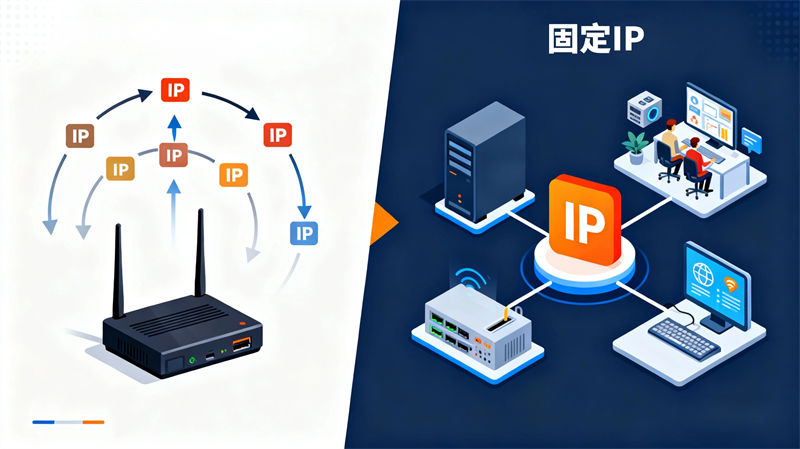
Many people at first heard the word fixed IP, and thought and general proxy is no different, are an IP an IP change. In fact, this is not the same thing. Ordinary proxy is "Offer you a new IP.", and a fixed agent is "Provide a fixed IP that you can use at any time".
Let's say you run a long time data collection, script automation, information monitoring and other tasks, if the IP has been the same, then the other site is likely to think that you are not normal visitors, start popping up the verification code, limit the traffic, or simply reject your request. Fixed IP is different, you can let the platform know that you are coming from the same IP, so you don't need to repeat the verification, and it won't be easy to trigger the risk control.
Account management is likewise a common difficulty. Many platforms are not familiar withlanding positionVery sensitive. For example, if an account is in Shanghai today, Singapore tomorrow, and Europe the day after tomorrow, even if you personally have no problem, the system will think that you are operating in bulk, or the account has been stolen. Especially foreign social networking platforms and cross-border e-commerce platforms, their risk control is very strict, if the IP changes frequently, it is easy to be locked or require identity verification.A fixed IP solves this problem and allows the account to always be in a stable login environment, which naturally reduces the risk.
Another common scenario is that you set up a server, a system, or an API and want others to have access to it at all times. If the exit IP is constantly changing, the other person can't find you. A fixed IP ensures that all devices have the same output address, so the system is more stable.
People engaged in foreign trade, cross-border e-commerce, market research and other industries need fixed IPs more than others because they need to visit sites in a particular country or region. When you are comparing data or looking at the effectiveness of local advertising, frequent IP changes can have a direct impact on the results. Fixed IPs allow for uniformity in access regions, which makes data more accurate.
Of course, the quality of the service provider IP and the stability of the line is very important. Some fixed IPs, themselves "dirty IP”,被人滥用了,如果你用它登陆网页,会被直接扣分的。一些线路具有高和低速度,并且在使用后不久就中断并且随后导致任务失败。
There are many such services on the market, and how to choose is a question?IPIPGOIts performance in this regard is stable. Its IP resource library covers more than 220 countries and regions around the world, and it has a huge amount of home IP resources, which can be switched statically and dynamically, and it is suitable for short-time data collection, long-time account management and site monitoring, and it is quite flexible. It also does a good job of encrypting its transmission with exclusive IPs to avoid shared associations, which is more friendly to cross-border e-commerce and overseas social media.
IPIPGO's technical support is even more worry-free, 24/7 service, API documentation, SDK and other supporting tools are also readily available, and developers can easily get started.
If you want a more stable and controlled network environment, then a fixed IP proxy can reduce many unnecessary problems.




 English
  简体中文
简体中文  Español
  Deutsch
  Français